Sunday, August 09, 2009
The path to love
That is very hard. But it is not impossible. A Jewish man by the name of Jesus of Nazareth had this capacity. A Hindu man by the name of Mahatma Gandhi had this capacity. A Catholic woman by the name of Agnesë Bojaxhiu (Mother Teresa) had this capacity. The Tibetan Buddhist Dalai Lama has this capacity. The Anglican Desmond Tutu has this capacity. Others have had and have this same capacity, in various degrees.
I'm not sure exactly how they developed the capacity to love with such perfection or near-perfection. But here's a path that seems to make sense to me...
First, you have to allow yourself to quiet your mind, seek silence. This silence is obtained through meditation or contemplative prayer, or simply stillness. I've found that silence has a way of enabling your ability to listen. Listening is probably the hardest thing for us humans because it requires us to withhold judgment, opinions, criticisms, righteousness... getting in the last word.
But listening is an extremely important step because it leads to awareness of your true self and the world around you. It enables you to realize that your true self is not your mind, your physical body, your possessions, your ego, your desires. It enables you to fully understand that you are not the cener of the universe and that you are in fact... impermanent. It enables you to see that you are not alone, but rather are merely a part of a greater whole. Once you observe that you are not a separate entity, you are more likely to start observing with enhanced clarity all that which is outside of you.
This greater awareness has a way of moving you toward engaging more with other people, pushing you out of your safe environments, fortresses, and isolated states. The more aware you become, the more you are inspired to want to establish relationships with people for no other reason than to get to know them, be with them. This is pure engagement with no hidden agendas.
Engagement has a funny way of leading to empathy... a capacity to put yourself in the body and mind of another person and feeling what it is to walk in their shoes.
Empathy is just a short hop, skip and a jump away from feeling compassion.
Compassion stimulates your desire and willingness to act on behalf of another.
The more you act out your sense of compassion, the more you perfect that thing we call love, the more you allow "God" to manifest and be present.
In summary... Silence leads to Listening. Listening leads to Engagement. Engagement leads to Empathy. Empathy leads to Compassion. Compassion leads to Love.
And of course love is the way you change the world.
Easy.
Wednesday, February 14, 2007
Hell was a local garbage dump
The Greek word Gehenna (or Gehenom or Gehinom) refers to a fiery place where the wicked are punished after they die or on Judgment Day. It traces its origin to the Hebrew Gêhinnôm (also Guy ben-Hinnom) meaning the "Valley of Hinnom's son".
According to the Wikipedia, "The valley forms the southern border of ancient Jerusalem and stretches from the foot of Mt. Zion, eastward, to the Kidron Valley. Originally it referred to a garbage dump in a deep narrow valley right outside the walls of Jerusalem where fires were kept burning to consume the refuse and keep down the stench. It is also the location where bodies of executed criminals, or individuals denied a proper burial, would be dumped. In addition, this valley was frequently not controlled by the Jewish authority within the city walls; it is traditionally held that this valley was used as a place of religious child-sacrifice to Moloch by the Canaanites outside the city."
So is the garbage dump in the valley of Hinnom's son what Jesus was talking about when he reffered to, “Hell, the unquenchable fire”. In Mark 9:43, where Jesus is supposed to have said, "If your hand causes you to sin, cut it off. It is better for you to enter life maimed than with two hands to go into hell, where the fire never goes out", was he simply using the commonly known local dump as a metaphor for just one heckuva bad state of being? If so, then why do so many Christians think of hell as an actual physical place people go to after they die?
In one of his sermons at the Washington National Cathedral, Rev. Eugene Sutton, notes, "It never ceases to amaze me that that particular exaggeration of Jesus becomes a literal fact of the afterlife in the consciousness of so many people. I’m afraid it says more about the fear and insecurity of the hearers who are taught to think of God as a vengeful and frightful being, than it does about the Compassionate One who sometimes used 'holy hyperbole' in order to get people to rethink their priorities and get their spiritual houses in order before it’s too late."
Thursday, February 01, 2007
Inspiration from God
Wednesday, January 31, 2007
Ehyeh asher ehyeh
A great book
No doubt there is a tremendous tradition behind the Bible. The book (in one form or another) has been around for nearly 2,000 years. Clearly, it's a great book. Lots of stories and poetry. Lots of worthwhile advice. The book has staying power. It's been translated and re-translated thousands of times. It's been edited and re-edited over and over again. It's been published and re-published endlessly.
It's a great book. But where did all this Word of God stuff originate? A Jewish guy writes a few letters (containing words of wisdom) to some home church communities that he helped found, and all of a sudden they're being called "epistles" and being quoted as the Word of God.
Wednesday, June 28, 2006
Living in the spirit
The message of unbridled love and compassion was the core of Jesus' teachings. That was the pistis Christou that Paul talked about... the "faith of Christ".
Note that love and compassion don't always "appear" to bring peace in the here and now or to you and those close to you. You have to think of peace in a broader, timeless and more Spiritual sense. You have to find a way to disassociate your SELF from your physical body and mind. You have to believe that your true SELF is not your body and mind, but rather your Spirit.
Ultimately, this way of fully realizing your Spiritual nature and being able to think, act and do in the Spirit, rather than in the interest of your ego, is the journey that each of us must undertake. I believe that this is the purpose of our physical lives... to reconnect to our true SELF, our essential Being.
Scripture provides some helpful guides, but I do not think it provides all the answers for everyone. You can often tell when Scripture is written from an ego-centric perspective, rather than out of love and compassion. When you sense that, that is when you should be concerned that the guy(s) or gal(s) who wrote the piece may just have missed the point.
In the final analysis, I believe you have to trust your true SELF, your Holy Spirit. You have to listen. You listen through contemplative prayer, meditation, and silence. And you practice unbridled love and compassion every moment you can, as if that moment were the last here on earth.
Friday, June 16, 2006
Critiquing scripture
But I do not believe that the Bible is the inerrant Word of God. I see this body of work as written and assembled by human beings. I think that much of Scripture has long-term relevancy. Some of Scripture has already proven to have outlived its relevancy. Time will continue this process.
I think much of Scripture is extremely flawed or worse, and I do not think that it was God-inspired... And thus I think it should be thoroughly critiqued and certainly not observed. Personally, I have no doubt that you and I are just as enlightened or more so than many of the writers of Scipture. We've had the benefit of history and a wider sociological education.
One of the greatest dangers that exists is when we take a collection of work written by human beings and give it the status of God. Remember the story of the finger pointing to the Moon? Scripture is the finger. It is not the Moon. Thus, it should not be worshipped. It should be used to bring us closer to God. It is not God. Neither is the Koran. Neither is the Book of Mormon. Neither is any "sacred" book. In my view, they are wisdom on paper... some of the wisdom is good, some not so good.
Scipture has been used to justify some of the most horrendous acts perpetuated by one human against another. In some cases, Scripture has simply been mistranslated and(or) misinterpreted. In other cases, Scripture has just flat out been wrong... in my humble opinion.
Monday, June 12, 2006
The cleansing of the temple
Traditionally, the story is interpreted as Jesus overturning the tables of the money changers and bird sellers as way to show his condemnation of using the Temple for the purpose of conducting business. The idea is that God's Temple is holy and should only be used for prayer and worship... kind of like our church.
On the surface, this interpretation makes complete sense.
However, it is entirely possible that this interpretation may be missing some facts that would change it rather dramatically.
In his book, The Trial of Jesus, Alan Watson notes:
"The sellers were there for the benefit of pilgrims who had come to sacrifice as Passover. Animals for sacrifice had to meet stringent requirements and would not be easily found by those coming for the festival if it were not for the sellers in the Temple precincts. No prohibition against buying sacrificial animals in the Temple existed, and Mishnah Shekalim 7.2 show incidentally that the presence there of the sellers was both lawful and known. The sale of doves for sacrifice in the Temple at any time was even controlled by Temple authorities."
Jesus was an obervant Jew. He would not have objected to the Temple system of making sacrifices to God. That was the accepted tradition for the Temple, and particularly so during the Feast of Passover when Jewish pilgrims traveled to Jerusalem to celebrate Israel's liberation from Egypt and to offer animal sacrifices.
I think the reason traditional Christianity has taken the "anti-business in a holy place" interpretation is that it has not seen the incident from the Jewish perpective. It has perhaps failed to put "Jesus the observant Jew" in that story.
In the recent book, The Last Week, by theologians Marcus Borg and John Dominic Crossan, the authors stress that Jesus' consistent and primary message was to proclaim the coming of The Kingdom of God and to challenge the dominant political system: the Romans and their local collaborators (the ruling Jewish class dominated by the Sadducees, Pharisees and Scribes). That ruling class had its base of operations in the Temple.
Jesus' attack on the money changers and bird sellers was much more than an attack on simple tradesman. It was less about defiling the Temple with needed and commonly accepted money transactions and more about attacking the power structure of Jewish society at the time. The "den" of thieves refers to the safe haven of the thieves -- the Roman collaborators who ran the Temple.
Jesus' teachings were mostly and consistently about social justice. They strongly opposed the domination system of the time and thereby probably any system that creates an elite and powerful class that keeps the masses poor and powerless... for whatever reason. Jesus was a social revolutionary, a radical. He wanted to change the status quo, and that of course ended up getting him into a heckuva lot of trouble.
I often wonder what Jesus would think of the US and capitalism. I wonder what he would think of the world's free market system, where essentially the strong, influential and clever do very well and the vast majority of our brothers and sisters are either dying of hunger or are barely able to earn a living.
If we simply interpret the cleansing of the Temple story in the traditional manner, all you have is a critique against "defiling" a holy place of worship -- a physical structure made of stone. The assumption is that somehow the Source of the universe, of all creation is offended by a few businessman. I have no idea what to DO with this lesson.
However, if we interpret the story from the standpoint opposing the domination of the people by a small elite class collaborating with a foreign occupying power (Rome) and truly establishing the "Kingdom of God" on earth in the here and now, then the message is clear.
We are called to transform our world by seeking justice, a fair distribution of the resources that God has temporarily "lent" us.
I grant you, this is pretty radical stuff. It is revolutionary. It almost sounds un-American. It is the kind of stuff that people who might try to implement this Way would likely be persecuted, even killed. Sound familiar?
Wednesday, May 31, 2006
Missing the point about sin
I have just started to read an exceptional book by Eckhart Tolle titled, "A New Earth". Tolle is also the author of the book, "The Power of Now", which I have tried to work through on three separate occasions and have failed. (I will try again...)
"A New Earth" seems to be much more accessible. Tolle succeeded in quickly drawing me into his new book with some of his thoughts on the concept of Sin. Let me share this with you...
Tolle says: "According to Christian teachings, the normal collective state of humanity is one of 'original sin.' Sin is a word that has been greatly misunderstood and misinterpreted. Literally translated from the ancient Greek in which the New Testament was written, to sin means to miss the mark, as an archer who misses the target, so to sin means to miss the point of human existence. It means to live unskillfully, blindly, and thus to suffer and cause suffering. Again, the term, stripped of its cultural baggage and misinterpretations,points to the dysfunction inherent in the human condition."
Monday, March 06, 2006
The book of Bart
By Neely TuckerSunday, March 5, 2006
CHAPEL HILL, N.C. Where does faith reside? In the soul? The mind, the marrow of the bones?
In the long hours of the night, the voices of the evangelical preachers on the AM dial seem to know. Believe, they say. Then daylight comes and the listeners' questions fade.
Bart Ehrman is a sermon, a parable, but of what? He's a best-selling author, a New Testament expert and perhaps a cautionary tale: the fundamentalist scholar who peered so hard into the origins of Christianity that he lost his faith altogether.
Once he was a seminarian and graduate of the Moody Bible Institute, a pillar of conservative Christianity. Its doctrine states that the Bible "is a divine revelation, the original autographs of which were verbally inspired by the Holy Spirit."
But after three decades of research into that divine revelation, Ehrman became an agnostic. What he found in the ancient papyri of the scriptorium was not the greatest story ever told, but the crumbling dust of his own faith.
"Sometimes Christian apologists say there are only three options to who Jesus was: a liar, a lunatic or the Lord," he tells a packed auditorium here at the University of North Carolina, where he chairs the department of religious studies. "But there could be a fourth option -- legend."
Ehrman's latest book, "Misquoting Jesus: The Story Behind Who Changed the Bible and Why," has become one of the unlikeliest bestsellers of the year. A slender book of textual criticism, currently at No. 16 on the New York Times bestseller list, it casts doubt on any number of New Testament episodes that most Christians take as, well, gospel.
Example: A crowd readies itself to stone an adulterous woman to death. Jesus leans down, doodles in the dust. Says, let the one without sin cast the first stone. The crowd melts away. It's one of the most famous stories in the Bible.
And it's most likely fiction, says Ehrman, seconding other scholars who say scribes added the episode to the biblical canon centuries after the life of Christ.
There are dozens of other examples in "Misquoting Jesus," things that go to the heart of the faith, things that have puzzled scholars for centuries. What actually happened to Jesus of Nazareth, there on the sands of Judea? Was he a small-time Jewish revolutionary or the Son of God? Both? Neither?
These ancient questions have been the guideposts to Ehrman's life. His take on them -- first as devout believer in biblical inerrancy, then as a skeptic who rejects it all -- suggests a demand for black and white in an arena where others see faith, mystery and the far traces of the unknowable.
"I think Bart is writing about his personal journey, about legitimate things that bother him," says Darrell Bock, research professor of New Testament studies at the Dallas Theological Seminary. Like many Christian scholars who have studied the ancient scrolls, Bock says his faith was strengthened by the same process that destroyed Ehrman's.
"Even if I don't have a high-definition photograph of the empty tomb to prove Christ's resurrection, there's the reaction to something after Christ died that is very hard to explain away," Bock says. "There was no resurrection tradition in Jewish theology. Where did it come from? How did these illiterate, impoverished fishermen create such a powerful religion?
"I can appreciate people feel differently. But sometimes I wonder if we are not all guilty of asking the Bible to do too much."
Void in His Heart
On a recent afternoon, Ehrman, 50, pulls off his fedora at the front of an auditorium. Some 350 students are filing in for Religion 22, one of the most popular classes on campus.
His text for today is the Gospel of John.
Thought to be the last written of the four Gospels that form the narrative of Christ's life, death and resurrection, it forms a cornerstone of the Christian faith. The problem is that it is distinctly different from the other three Gospels.
Ehrman looks the professorial part -- a not-too-tall man with a receding hairline, dressed in casual slacks and sport coat over a sweater. His shoes are scuffed. He is energetic and possessed of a gregarious personality that endears him to the student body. (He holds informal office hours on Wednesday nights in a local bar/restaurant.)
But as he paces back and forth across the stage, Ehrman ruthlessly pounces on the anomalies -- in this Gospel, Jesus isn't born in Bethlehem, he doesn't tell any parables, he never casts out a demon, there's no last supper. "None of that is found in John!" The crucifixion stories are different -- in Mark, Jesus is terrified on the cross; in John, he's perfectly composed. Key dates are different. The resurrection stories are different. Ehrman reels them off, rapid-fire, shell bursts against the bulwark of tradition.
"In Matthew, Mark and Luke, you find no trace of Jesus being divine," he says, his voice urgent. "In John, you do." He points out that in the other three books, it takes the disciples nearly half of Christ's ministry to learn who he is. John says no, no, everyone knew it from the beginning. "You shouldn't think something just because you believe it. You need reasons. That applies to religion. That applies to politics . . . just because your parents believe something isn't good enough."
The class files out a few minutes later.
"Most of the students have never heard anything like this in their lives," says Ben White, a graduate student. "For a lot of them, it's very threatening."
Ehrman doesn't mind this. He's often on CNN, the Discovery Channel, National Geographic, a scholar amused by "taking something really complicated and getting a sound bite out of it."
"Misquoting Jesus" is just that to some extent, a book of pop history about biblical misconceptions. The first of his 19 books to be a bestseller, it reads like one of his lectures -- an exploration into how the 27 books of the New Testament came to be cobbled together, a history rich with ecclesiastical politics, incompetent scribes and the difficulties of rendering oral traditions into a written text.
To get an idea of how complicated this can be, consider: Greek, the lingua franca of the day, was written without capitalization or punctuation.
Here, you play biblical translator. Look at this, an example in English, from Ehrman's book: godisnowhere
Does it say: God is now here. Or: God is nowhere.
Sorting out these mysteries is the life Ehrman saw for himself since he was an uncertain teenager in Lawrence, Kan. He attended Trinity Episcopal on Vermont Street in Lawrence, but he and his family were casual in their faith. Lost in the middle of the pack in school, Ehrman felt an emptiness settle over him, something that lingered at nights after the lights were out, when the house was quiet.
One afternoon he went to a party at the house of a popular kid. It turned out to be a meeting of a Christian outreach youth group from a nearby college. In private talks, the charismatic young leader of the group told the 15-year-old Ehrman that the emptiness he felt inside was nothing less than his soul crying out for God. He quoted Scripture to prove it.
"Given my reverence for, but ignorance of, the Bible, it all sounded completely convincing," Ehrman writes.
One Saturday morning after having breakfast with the man, Ehrman went home, walked into his room and closed the door. He knelt by his bed and asked the Lord to come into his life.
He rose, and felt better, stronger. "It was your bona fide born-again experience."
The void in his heart was filled. The more he read the Bible, he says, the closer he felt to God.
His devotion soon engulfed him. "I told my friends, family, everyone about Christ," he remembers now. "The study of the Bible was a religious experience. The more you studied the Bible, the more spiritual you were. I memorized large parts of it. It was a spiritual exercise, like meditation."
He soon became a gung-ho Christian, a fundamentalist who believed the Bible contained no mistakes. He converted his family to his new faith. Schoolmates went off to the University of Kansas, but he enrolled in the Moody Bible Institute, an austere interdenominational institution in Chicago that forbade students to go to movies, play cards, dance, or have physical contact with the opposite sex.
It was spiritually thrilling.
For the next 12 years, he studied at Moody, at Wheaton College (another Christian institution in Illinois) and finally at Princeton Theological Seminary. He found he had a gift for languages. His specialty was the ancient texts that tried to explain what actually happened to Jesus Christ, and how the world's largest religion grew into being after his execution.
What he found there began to frighten him.
The Bible simply wasn't error-free. The mistakes grew exponentially as he traced translations through the centuries. There are some 5,700 ancient Greek manuscripts that are the basis of the modern versions of the New Testament, and scholars have uncovered more than 200,000 differences in those texts.
"Put it this way: There are more variances among our manuscripts than there are words in the New Testament," Ehrman summarizes.
Most of these are inconsequential errors in grammar or metaphor. But others are profound. The last 12 verses of the Gospel of Mark appear to have been added to the text years later -- and these are the only verses in that book that show Christ reappearing after his death.
Another critical passage is in 1 John, which explicitly sets out the Holy Trinity (the Father, the Son and the Holy Spirit). It is a cornerstone of Christian theology, and this is the only place where it is spelled out in the entire Bible -- but it appears to have been added to the text centuries later, by an unknown scribe.
For a man who believed the Bible was the inspired Word of God, Ehrman sought the true originals to shore up his faith. The problem: There are no original manuscripts of the Gospels, of any of the New Testament.
He wrote a tortured paper at Princeton that sought to explain how an episode in Mark might be true, despite clear evidence to the contrary. A professor wrote in the margin:
"Maybe Mark just made a mistake."
As simple as it was, it struck him to the core.
"The evidence for the belief is that if you look closely at the Bible, at the resurrection, you'll find the evidence for it," he says. "For me, that was the seed of its own destruction. It wasn't there. It isn't there."
Doubt about the events in the life of Christ are hardly new. There was never clear agreement in the most ancient texts as to the meaning of Christ's death. But for many Christians, the virgin birth, the passion of Christ, the resurrection on the third day -- these simply have to be facts, or there is no basis for the religion.
"The fundamental truth claims of the biblical record were historical things that were believed to have happened, not 'once upon a time' in a fairy tale or somewhere outside of time and space, but at specific times and places that belonged to the total history of the human race and that could be located on a map," writes Jaroslav Pelikan, one of the field's most respected scholars. "If the history of the resurrection of Christ had not really happened, the message . . . according to the authority of the apostle Paul, had to be 'null and void.' "
Ehrman slowly came to a horrifying realization: There was no real historical record. It was, he felt, all incense and myth, told by illiterate men and not set down in writing for decades.
Dark Bubbles
It is a difficult thing to chart the loss of faith.
Where does it go, this belief in things not seen?
Let's look at "In the Beauty of the Lilies." This is John Updike's novel of the fictional Rev. Clarence Arthur Wilmot, a Presbyterian minister, and his loss of faith. Wilmot, beset by doubt one afternoon in the rectory, "felt the last particles of his faith leave him. The sensation was distinct -- a visceral surrender, a set of dark sparkling bubbles escaping upward . . . there was no God, nor should there be."
For Ehrman, the dark sparkling bubbles cascaded out of him while teaching a class at Rutgers University on "The Problem of Suffering in Biblical Traditions." It was the mid-1980s, the Ethiopian famine was in full swing. Starving infants, mass death. Ehrman came to believe that not only was there no evidence of Jesus being divine, but neither was there a God paying attention.
"I just began to lose it," Ehrman says now, in a conversation that stretches from late afternoon into the evening. "It wasn't for lack of trying. But I just couldn't believe there was a God in charge of this mess . . . It was so emotionally charged. This whole business of 'the Bible is your life, and anyone who doesn't believe it is going to roast in hell.' "
He kept teaching, moving to Chapel Hill, kept hanging on to the shreds of belief, but the dark bubbles fled upward. He was a successful author, voted one of the most popular professors on campus, but he awoke one morning seven years ago and found the remnants of faith gone. No bubbles at all. He was soon to marry for the second time and his kids were grown. He stopped going to church.
"I would love for him to be there with me, and sometimes wish it was something we share," says Ehrman's wife, Sarah Beckwith, a professor of medieval literature at Duke University, and an Episcopalian. "But I respect the integrity of decisions he's made, even if I reject the logic by which he reached them."
"Bart was, like a lot of people who were converted to fundamental evangelicalism, converted to the certainty of it all, of having all the answers," says Dale Martin, Woolsey Professor of Religious Studies at Yale University, and a friend of three decades. "When he found out they were lying to him, he just didn't want anything to do with it.
"His wife and I go to Mass sometimes. He never comes with us anymore."
Life after the loss of faith, even for the deeply religious, is not necessarily a terrible thing.
Ehrman tools home from campus on a recent morning in his BMW convertible. He has a lovely house in the countryside, a wife who loves him and an ever-growing career. He is, he says, a "happy agnostic." That emptiness he felt as a teenager is still there, but he fills it with family, friends, work and the finer things in life.
He thinks that when you die, there are no Pearly Gates.
"I think you just cease to exist, like the mosquito you swatted yesterday."
On this particular morning, he turns his attention to his new book, the story of Judas Iscariot, the man who betrayed Christ. Judas resides, according to Dante, in the ninth circle of hell.
Ehrman's desk is filled with open books. His study is sun-filled, with a glass door giving onto a patio and the gentle pines of the Carolina forests.
Where does faith reside? Does it leave a residue when it is gone?
Bart Ehrman begins writing, the day unfolding, shafts of light falling through the window, the mysteries of the Gospels open before him.
Wednesday, February 22, 2006
Was Jesus a fair man?
Jesus preached justice throughout his ministry. I think he taught us how to implement justice in our world. I think Jesus is the epitomy of justice.Yet, I do not think Jesus was a fair man.
If you look at what he taught us to do, they aren't actions or ways of thinking that we would consider to be "fair".
- Love everyone, including those who hate you? NOT FAIR!
- Forgive those who have hurt you or someone you love? NOT FAIR!
- Give up your worldly possessions and follow The Way? NOT FAIR!
- Do not judge others? KIND OF NOT FAIR!
... You get the idea.
Jesus was not a fair man. I don't think the issue of fairness really entered his mind because it was beside the point. The issue was justice.
Now the question is... "What is justice?"
I think a good starting point on the way to answering that question is looking at how Jesus went about implementing justice. He did it through (... yep, here we go again) unconditional love, compassion, kindness, forgiveness, nonjudgmentalism...
This is pretty powerful stuff. I think it has the power to change our lives and our world for the better. I think it has the power to bring us into unity, into oneness, into a state of perfect peace with God. I think that was the whole point of Jesus' life. I think that is path to "transformation".
Tuesday, November 29, 2005
Salvation is about healing
Deborah Caldwell of Beliefnet interviewed Marcus Borg about a year ago regarding his book, "The Heart of Christianity". I found Borg's response to Caldwell's question on salvation to be very interesting because it really shows the relation between salvation and establishing the Kingdom of God in the here and now through mission and peace & justice efforts.
I very much like Borg's view that salvation is not about going to heaven and living happily ever after, but rather about healing. I am also fascinated by Borg’s view that relating salvation with going to heaven “impoverishes” the meaning of the word. I believe that the moment you start talking about salvation and heaven in the same sentence, that’s when you start to divide humanity by creating a sort of competition between those who may go to heaven and those who may not.
>>
Question: How do you talk about a word like "salvation" in this new [post-modern] paradigm?
Answer: In the Bible, salvation is mostly concerned with something that happens in this life. Even in the New Testament, the primary meaning of the word "salvation" is transformation in this life. One can see this in the roots of the English word salvation, which comes from "salve," which is a healing ointment. Salvation is about healing. We all grow up wounded, and salvation is about the healing of the roots of existence.
Question: Sounds like a mid-life crisis.
Answer: Well, yeah. And the Bible has specific images of salvation. Salvation is about light in the darkness, liberation from bondage, return from exile, or reconnection with God. It's about our hunger being satisfied, our thirst being quenched, and so forth. The identification of salvation with "going to heaven" in much of popular Christianity not only impoverishes the meaning of salvation but I also think really distorts what being a Christian is all about.
Whenever the afterlife is made central to being Christian, it invariably turns Christianity into a religion of requirements. If there is an afterlife, it doesn't seem fair that everyone gets to go there regardless of what they do before death, so there must be something you have to do or believe. And then suddenly Christianity ceases to be a religion of grace and instead becomes a religion of measuring up to what God requires.
Monday, November 21, 2005
We average Christians
Frankly, I’m not sure that young people have ever flocked to the church. But there seems to be a sense that the situation has worsened. If this is so, I can’t say that I am surprised, given what we see and hear in the news about the Church, be it Catholic, Episcopal, Baptist, Mormon. I won’t go into specifics. You all know what I’m talking about.
Indeed, why should anyone in their youth wish to be a Christian? In theory, Christianity offers a great deal. However, when you see Christians in our society, there really isn’t much that distinguishes them from other people.
Christians are happy and sad. Christians are nice and not so nice. Christians are easy to get along with and some are difficult to be around. Christians have answers for some of life’s problems, and sometimes they haven’t a clue. Christians are tolerant and intolerant. Christians have huge egos and tend to focus on themselves, and some are very giving and selfless. Christians are forgiving and also vengeful. Christians are gentle and kind, and some of us are violent and aggressive. Christians are committed to their families and communities, but some are not.
In other words, Christians are average human beings. Aside from the promised “reward of “salvation” sometime in the future after we exit the physical world, what is it exactly that makes being a Chrisitan attractive? What are the tangible benefits in the here and now? What do we think, do, and say that is so radical and revolutionary that will contribute to making us better human beings and our world a noticeably better place to live for everybody?
I know that in theory, we Christians have some pretty good answers to the problems that people, communities, and nations encounter every day. We have some of the most powerful ways of dealing with both the simple and complex stuff.
The question is, “Do we practice what we have learned from our Teacher?” For it is the practice of what we’ve been taught by the Master that creates that kind of energy and excitement that draws people to our movement, especially those who are young and hungry knowledge, wisdom, and truth.
Friday, November 18, 2005
Missional hesitation
When we believe that ours is the only way to attain eternal Oneness with God, then we automatically create division within humanity. It is this perception of division, I feel, that pushes us toward "our kind" and encourages us to keep away from "them".
We can only be truly missional by emptying ourselves completely, always looking outward beyond our safe borders... and never seeing the differences, never judging. It's not up to us anyway.
Wednesday, November 16, 2005
Peace through justice
I just read a recent interview with New Testament scholar John Dominic Crossan, which I found very interesting. However, it is the part that deals with the attaining of peace that mostly caught my attention.
Traditionally, movements, governments, individuals seeking to attain peace in the world have tried to do so through winning. Unfortunately, victory usually means that someone wins and someone loses. As a result, victory consistently fails to establish real, long-lasting peace.
We in the West especially place a high value on winning, whether it has to do with sports contests, political elections, or job promotions. All of these things are ego-based... they are about us.
I think that we followers of Jesus, we humans, we citizens of the world must learn to empty ourselves to others and place less emphasis on winning and more emphasis on sincerely caring for and about others. These are the first steps toward living a life focused on seeking justice. And it is justice that leads to true peace.
>>
QUESTION: What analogies would you draw between 21st-century America and the Rome of early Christianity?
ANSWER: The Roman imperial program could be summarized in the motto "First victory, then peace." Or, alternatively, "Peace through victory." The program of Jesus, and, following him, of Paul, was establishing peace not through victory but through justice.
The great theological clash in the first century between Caesar as divine or Jesus as divine was a choice between two methods of establishing global peace. After 2000 years, we are still using those same two methods – violent war, or nonviolent justice.
Generally speaking, the option of peace through victory has nevere stablished peace, but little more than a lull. Afterwards, the violence starts up again and always even more violent than before.
Monday, November 14, 2005
John 14:6
"I am theway, the truth, and the life. No man comes to the Father but through Me." (John 14:6)
This verse has always nagged at me because it is so often used to"prove" that Jesus Christ is the ONLY way to God. Instinctively, I've disagreed with this for as along as I can remember. In my opinion, itis one of the most destructive verses in the Bible because it has beenused throughout the ages to justify intolerence and many moreunpleasant ways of treating those who are not "Christians".
Obviously, I have a huge problem with this because it is so utterly un-Jesus-like (to me, anyway). To use this verse as anything akin to "proof" that would justify exclusivism is in my opinion extremely simplistic.
Additionally, it assumes many things... not the least of which is the unquestioned authority of the community or individual who wrote the Gospel of John. Many traditional scholars attribute authorship of the Gospel of John to the "beloved disciple" of Jesus - John of Zebedee. But this is not anywhere close to being factual. John of Zebedee was apparently beheaded by Agrippa I in 44 CE, long before the Gospel of John was written (sometime around 100 CE).
Without knowing really who wrote the Gospel of John, my tendency would be to read what the writer(s) wrote and reflect upon it... and see in which ways the wisdom points to God, and in which ways it does not. Of course, one can debate endlessly about such things as the meaning, the interpretation, and the authority of Scripture. At some point, you have to simply agree to disagree. I accept that.
What I do not accept are poor or inaccurate translations of theoriginal scripture written in Aramaic or Hebrew.
Note that in the original Aramaic, the word that was translated into the Greek to mean "I" in John 14:6 is "ena-ena". The problem is that ena-ena does not actually mean "I" as we understand it. It does not mean the "individual I", but rather "I-I"... In other words, the "cosmic I", as in "I AM THAT I AM (Exodus 3: 13-14).
My understanding of John 14:6 is that Jesus was referring to his Father in heaven... the great "I AM" or Yahweh.
Also, in the original Greek version of this scripture, the word for"comes" is "erchetai"." Erchetai" has a very present tense meaning, feel. It does not apply to all people for all time. In John 14:6, Jesus was speaking to his disciples, trying to comfort them after telling them he would soon die.
My understanding is that the more accurate translation of John: 14:6 is:"Yahweh is the truth, the way, and the life. No one of you here comes to the Father but through me."
Keep in mind, though, I am not an exclusivist. I am a universalist. I believe that there is one Creator of the universe. I believe the Creator reveals truth and enlightenment in different ways to different people in different cultures in different worlds in different galaxies at different times.
Friday, August 26, 2005
What would Jesus say, do?
The other day when Pat Robertson made his rather bizarre comments about killing Venezuela's president, I immediately thought... "What would Jesus say?" Rather than debating whether something is biblical or not (which often depends on one's interpretation or personal biases), I usually go the more direct route and try to visualize Jesus of Nazareth either shaking his head forcefully and frowning or nodding slowly with a slight grin on his face. In the case of Pat, I regularly visualize a frowning Jesus.
I've been thinking about Jesus and Scripture a lot lately. I've been focusing on the many times that Jesus set aside the Torah and opted to respond to human need. There seems to have been a pattern within Jesus' thoughts and actions when it came to following the Law or giving his love and compassion to human beings. The pattern is that love and compassion always won out.
In the third chapter of Mark and the sixth chaper of Luke, Jesus was quoted as having said... "The law was made for man, not man for the law, the Sabbath was made for man, not man for the Sabbath".
There is sometimes a tendency to view Scripture as infallible, inerrant because supposedly it is the "Word of God", rather than the human interpretation or experience of God's wisdom (... my preference, of course). In my opinion, when this happens the danger is that we may be tempted to view Scripture as God and ultimate Truth, rather than something pointing to God and ultimate Truth. In other words, we start to worship, idolize Scripture... and that is precisely what Jesus was critical of. That is precisely what I view as dangerous within Christianity.
In the words of one of my favorite authors, Fr. Joseph F. Girzone... "Where there is a human need the law must bend. It is God's children who are sacred to God, not laws. Laws are to protect or assist God's children. If a law does not do that, it should be re-evaluated, and, perhaps, abrogated."
"One cannot help but think of religious laws and customs today that may have had meaning at one time but are a hindrance to the healthy practice of spirituality in our times. This is not to say that morality should change, but there are many religious laws that have nothing to do with the moral law. They are merely arbitrary ordinances that could be changed. Often people's attachment to traditions and customs resist changing them even though they may cause of occasion untold damage to many good people. When religious leaders see the damage done, one would think as good shepherds concerned for the sheep they would be the first to recognize the need for change. It is difficult to understand their obsessive attachment to customs and practices when they more often give rise to scandal than inspire goodness. It might do well for the religious leaders of all the denominations to re-evaluate practices that are totally out of sync with the mind and spirit of Jesus, and which many good people no longer observe because they know they are foreign to the mind of Jesus."
One can twist Scripture to support any thought process, any speech, or any action in which one might choose to engage. Some are laughably, obviously twisted and un-Jesus-like... such as Pat's comments about Hugo Chavez. Others are more debatable.
Again, though, my litmus test is always... "What would Jesus say (and do)?"... based on what we know of Jesus' personality and teachings.
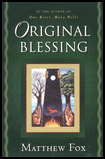
Original blessing
I am currently reading Matthew Fox's book, Original Blessing. I like Fox's exploration of the myth of "original sin", on which so much of Christian doctrine is based. Probably the guy that has harmed Christianity is Augustine with this invention of his. So much of Christian thinking is based on the inherent sinfulness of humanity, based on original sin, and the need for atonement. This whole concept God becoming incarnate in the person of Jesus of Nazareth for the sake of him/her becoming the ultinate blood sacrifice to make up for the fall of Adam and the passing on of original sin has always sounded silly to me. But I always thought, "What the heck... nice story."Unfortunately, the story has done a lot of damage because it has been used throughout the centuries by the Church to make people feel unworthy, guilty, and inherently evil. The focus has been on attaining "salvation" from this evil through acceptance of the ultimate price that God/Jesus paid to rescue us. The line goes, "By accepting that Jesus Christ died for our sin(s), we are cleansed and thus saved."
It is refreshing to read the contrary view that humankind is essentially good because we are the perfect and divine product of God's creation. Creation theology is much much older the the theology based on Adam's fall. It is positive rather negative.
The problem for traditional Christianity is that does not provide the same opportunity to coerce people into following the teachings of the Church. Take away guilt and feelings of being unworthy, and people perhaps don't need the Church as much. It also makes it much more difficult to explain the Incarnation, the Death, and the Resurrection. What's the point of the God's sacrificial lamb when human's have nothing for which to atone? What's the point of this myth when the relationship between God and his/her creation has always been just fine, thank you. God created us as an act of love, grace. We were "originally blessed", not originally damned.
Tuesday, August 23, 2005
"Do-it-yourself" religion
He's probably alluding, at least in part, to some of the post-modern thinking which is gaining ground these days, questioning many of the core tenets of traditional theologies and doctrines. The Pope was quoted as saying, "But religion constructed on a 'do-it-yourself' (DIY) basis cannot ultimately help us."
I have not read the full text of the Pope's address, and I obviously was not present to listen to the tone in which it was given. So I will reserve full judgment as to the Pope's intent. However, I do get the feeling that this yet another effort by the Church to discourage individuals from thinking for themselves and seeking a relationship with God in a way that is not limited to those things that are "authorized" by this earthly institution.
One of the discussions in which I would love to engage has to do with the authority of Church and the authority of the Bible. To me, the authority of any human institution, tradition, or document is either derived from superior force or from the consent of the people who they serve. The Church will of course claim authority from God. Many also claim the Bible's authority comes from God. But what good is this authority if no one acknowledges this authority? What good is it to have wonderful cathedrals and churches that are empty? What good is this authority when most people regularly ignore the Church doctrines and dogma. What good is this authority when the Church is becoming increasingly irrelevant? Irrelevancy is authority's great enemy.
Increasingly, I am sensing frustration and even desperation within the Church that it no longer has the force that it once did to enforce its rules and regulations, nor does it have the consent of the masses that it once did. My sense is that the reason churches in throughout Europe are empty has less to do with "corruption by popular culture" and more to do with the fact that traditional religion just doesn't make sense to people. It has probably never made much sense in the past, but now people are more willing to question and explore on their own without being fearful.
Another quote that I ran across in my readings is one by Charles W. Slaton in "Biblical Malnutrition & Today's Episcopal Church"... "We should all take issue with the notion that man inherits the right to update and revise Scripture as he sees fit. This is what the revisionist movement is all about, changing God to accommodate man."
Suffice to say, the arrogant tone in this one bothers me even more. No one is seeking to "change God". What people have always sought is to "better understand the mind of God". For better or for worse, all of Scripture doesn't speak to all of us. That does not mean that we are negating or seeking to change God. It simply means that we do not agree with some of the things that a guy or gal wrote a long time ago, and that we prefer to trust the spiritual insights gained through our own personal journeys.
Friday, August 19, 2005
The process of picking and choosing from scripture
I have no problem looking at something that Paul or one of the Gospel writers wrote and saying... "Hmmm, I think he got it right about Jesus" and "Well, I think he kind of blew it... no way the Jesus I know would subscribe to that".
There is nothing that says that I am not free to pick and choose from the Bible. Yes, it may sound "convenient" (maybe perilous)... but that doesn't bother me much. Fear is no longer an active element of my relationship with God.
The Bible was never meant to be a single work that makes sense for everybody throughout all the ages... It is the end-product of many unique and diverse documents assembled, edited, and translated over many years by various councils, motivated by many things (not always God). Thus, I do not feel bound to the work in its entirerity.
Whenever I sense a writer in the New Testament going down a path that runs contrary to unconditional and complete love, forgiveness, and acceptance for all (... especially "sinners"), then my radar automatically goes up. It's that simple. Scripture is
a tool for helping find the way, based on the teachings of Jesus.
Some Scripture is more helpful than others. And some Scripture is completely unhelpful.